Advising for SFS Programs

Field Research at the Source

Since 1980, advisors at more than 500 colleges and universities have sent students to SFS field stations to do environmental research.

Residential Cohort

Students live and do research together for the full program. The cohort model builds day-to-day accountability and relationships that last well beyond the semester.

Center Based

Every program operates from a permanent SFS field station. Students are embedded in the landscape they're studying.

Environmentally Focused

Every program is interdisciplinary by design, pairing ecology and field biology with environmental policy, economics, and social science. One environment, studied from every angle.

Directed Research

Student fieldwork feeds faculty-directed, multi-year research plans. The semester capstone, Directed Research, is a minimum 100 hours of fieldwork producing data that community partners and agencies use.

Applied Learning

Students run the science themselves: data collection, species identification, transect surveys, water sampling. The field itself is the classroom.

Part of the Community

Centers are longtime neighbors in their host communities. Students work alongside local partners on research questions that come from real stakeholder needs, and findings are presented back to the community at term's end.

Academic Credibility, Field-Level Depth

SFS faculty hold advanced degrees and run ongoing research that student fieldwork feeds directly into. Programs are based at permanent SFS field stations, and no formal agreement is required to send students.

For credit approval and pre-departure review, our Resources page holds the syllabus for every course, the Academic Handbook on credit transfer and grading, the current cost sheet, the Essential Eligibility Criteria, Policies & Procedures, and each center's Country Overview and Health & Safety Guide.

Semester
Duration
95–102 days
Credits
16–18
GPA Minimum
2.8 cumulative
Prerequisites
1 bio, ecology, or env science
Summer
Duration
4 or 6 weeks
Credits
4 or 6
GPA Minimum
2.6 cumulative
Prerequisites
None

The 12 Centers at a Glance

A quick read on each campus and its surroundings. Share these early to help students choose well, and select any card for the full Know Before You Go guidance.

Australia
The Center
A 153-acre rainforest campus on the Atherton Tablelands, its stilted cabins tucked into the hills.
Ecosystem
Tropical rainforest beside the Wet Tropics World Heritage Area.
Nearest Town
Yungaburra, 20 min (pop. 1,200) · Cairns, 90 min (pop. 150,000)
Highlights
  • Camping expedition in the Daintree, the oldest rainforest on Earth
  • Day trips to the Great Barrier Reef
  • Rainforest restoration with local community groups
Know Before You Go
Bhutan
The Center
A former hotel in the Paro Valley of the Himalayas, surrounded by conifer forests and river systems.
Ecosystem
Field sites from alpine meadows and mountain forests to river valleys.
Nearest Town
Paro, a 10-minute walk (pop. 12,000) · Thimphu, 1 hour (pop. 115,000)
Highlights
  • Treks through remote Himalayan villages and mountain passes
  • Gross National Happiness as environmental governance
  • Monasteries where Buddhist philosophy meets ecology
Know Before You Go
Cambodia
The Center
A campus in a quiet suburb of Siem Reap, with daily access to the city's shops, cafes, and temples.
Ecosystem
Tropical wet-dry climate of high heat, humidity, and seasonal monsoons.
Nearest Town
Central Siem Reap, 3 miles (pop. 250,000) · Angkor Wat, 6 miles
Highlights
  • The only SFS center with a city at its doorstep
  • Excursions to Angkor Wat and Phnom Penh
  • Freshwater ecosystems, environmental ethics, fish, and elephants
Know Before You Go
Chile
The Center
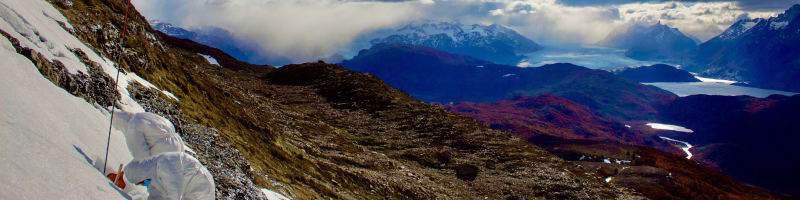
A former hostel in Puerto Natales, Patagonia's gateway to Torres del Paine National Park.
Ecosystem
Glaciers, fjords, mountains, grasslands, and coastal habitats.
Nearest Town
Puerto Natales, a 5-minute walk (pop. 18,500) · Punta Arenas, 3 hours (pop. 144,000)
Highlights
  • Glacial and freshwater ecosystems in a changing climate
  • Penguin colony surveys in Tierra del Fuego
  • Fieldwork in Torres del Paine and surrounding protected areas
Know Before You Go
Costa Rica
The Center
A rural campus among rolling hills and family farms, with a pool, soccer field, and outdoor classroom.
Ecosystem
Tropical climate moderated by elevation, from cloud forest to dry forest.
Nearest Town
Atenas, 3 miles (pop. 8,000)
Highlights
  • Farm-to-table meals from the campus's own fruit and vegetables
  • Coffee farms, co-ops, and national parks as field sites
  • Curriculum spans agriculture, Indigenous livelihoods, and climate
Know Before You Go
Croatia
The Center
A campus in the quaint seaside town of Veli Lošinj, on the island of Lošinj in the Adriatic.
Ecosystem
An evergreen island archipelago with hot, dry summers.
Nearest Town
Mali Lošinj, walking distance (pop. 7,500)
Highlights
  • Class time aboard research boats and along island coastlines
  • Sea turtle rescue, photo-identification, and GIS mapping
  • Basic wildlife veterinary techniques, a strong pre-vet fit
Know Before You Go
Italy
The Center
Student apartments in Greve, a bucolic Tuscan town in Chianti, a short walk from SFS classrooms.
Ecosystem
Tuscan wine and farm country in the Chianti hills.
Nearest Town
Greve itself (pop. 14,000) · Florence, 45 min (pop. 380,000)
Highlights
  • Weeklong excursion to the Aeolian Islands off Sicily
  • Language and food exchange in the English for Pasta program
  • Fieldwork from the Apennine mountains to the Maremma coast
Know Before You Go
Kenya
The Center
A camp of permanent safari tents in the Kimana wildlife corridor, in the foothills of Kilimanjaro.
Ecosystem
Savanna surrounded by national parks and Maasai conservancies.
Nearest Town
Kimana, a 5-minute drive (pop. 10,000)
Highlights
  • Expeditions to Amboseli, the Maasai Mara, and Ol Pejeta
  • About a week studying mountain gorillas in Rwanda (semester)
  • Weekly game drives, walking transects, and community visits
Know Before You Go
Panama
The Center
A former hotel on Isla Colón in the Bocas del Toro archipelago, on Panama's Caribbean coast.
Ecosystem
Coral reefs, mangroves, seagrass beds, and island rainforest.
Nearest Town
Bocas Town, a 10-minute drive (pop. 13,000) · Panama City, a 1-hour flight
Highlights
  • Reef, mangrove, and marine-protected-area surveys by boat
  • Tourism and climate impacts on island communities
  • Indigenous and local perspectives on stewardship
Know Before You Go
Peru
The Center
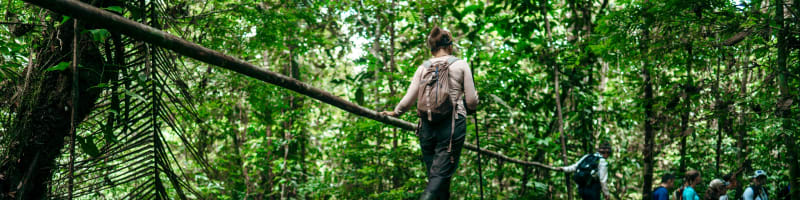
A former retreat center in the city of Tarapoto, in the Peruvian Amazon's San Martín region.
Ecosystem
Lowland and flooded Amazon rainforest, rivers, and cloud forest.
Nearest Town
Tarapoto, a 10-minute walk (pop. 180,000) · Lima, a 1.5-hour flight
Highlights
  • Forest health and recovery in one of Earth's most biodiverse regions
  • Development and extraction pressures on Amazonian communities
  • Indigenous knowledge systems in conservation
Know Before You Go
Tanzania
The Center
A 3-acre open-air campus with a volleyball court, gazebo, and fire pit, an easy walk from the village.
Ecosystem
Highlands between the Tarangire-Manyara and Ngorongoro-Serengeti ecosystems.
Nearest Town
Rhotia, a 5-minute walk (pop. 29,000) · Karatu, 15 min (pop. 280,000)
Highlights
  • Multi-day Serengeti camping, tracking predator movements
  • Bird and fish abundance studies at Lake Manyara
  • Wildlife encounters on the Ngorongoro Crater floor
Know Before You Go
Turks & Caicos
The Center
A former oceanfront hotel on South Caicos, with a saltwater pool and wild donkeys and flamingos nearby.
Ecosystem
An Atlantic island of reefs, sand flats, seagrass, and mangroves.
Nearest Town
The island's small town (pop. 1,500)
Highlights
  • The SFS dock puts the harbor a quick snorkel away
  • Optional SCUBA certification in semester and summer, never required
  • Rays, barracuda, dolphins, and whales for neighbors
Know Before You Go

Who Stands Behind the Academics

Independent oversight runs through the whole program, from the external board that governs SFS to the U.S.-accredited university that serves as its School of Record.

Board of Trustees

The School for Field Studies is governed by an external Board of Trustees that counts SFS alumni among its members.

Institutional Partners Council

The Institutional Partners Council brings faculty and administrators from partner colleges and universities into SFS governance, advising on academic quality from curriculum design to student outcomes.

School of Record

The University of Minnesota has served as the SFS School of Record since June 2014, working with SFS on program quality and issuing official transcripts. Schools can receive either a School of Record transcript or direct credit from SFS.

Learn More About Governance →

Advisor Site Visits

SFS hosts regular site visits for advisors, guided by the Center Directors and faculty who run each field station.

  • 2026Croatia & Italy
  • 2025Panama
  • 2024Kenya
  • 2023Costa Rica
  • 2019Kenya
  • 2019Bhutan
  • 2018Costa Rica & Panama
  • 2018Cambodia
  • 2017Tanzania
  • 2015Cambodia
  • 2014Australia
  • 2014Panama
  • 2013Turks & Caicos
  • 2012Costa Rica
Inquire About a Visit →

Who Thrives at SFS

Environmental science majors are the obvious referrals, and our strongest students also come from biology, political science, anthropology, pre-med, and economics. Disposition matters more than major.

  • 01 Courteous
  • 02 Ready for early mornings and shared space
  • 03 Looking for an academic challenge rather than a gap year
A tiny yellow poison-dart frog, speckled black, perches on the pink bracts of a heliconia bloom in Panama

Find Your Rep

Hover or tap your state on the map to see your contact, with a direct email link. The key below lists each rep's states, and each name is an email link too.

Ready to Send Your Students into the Field?

Browse all 29 program offerings across 12 centers, or line them up side by side in our comparison tool.