


Glacier. Fjord. Steppe. One Semester.
Wind tears across the steppe at eighty kilometers an hour, bending grass flat and sending guanaco herds into a trot. Behind them, the granite towers of Torres del Paine cut through low cloud while Grey Glacier calves another wall of ice into its lake. Quiet, enormous, and never the same light twice: Patagonia is where climate change is not a model or a projection. It is visible, measurable, and reshaping the landscape faster than the science can keep up.
Students camp for multi-day expeditions in Torres del Paine, observe the king penguin colony in Tierra del Fuego, trace Aónikenk and Selk'nam histories through rock art and site visits, and cross into Argentina to study Perito Moreno Glacier dynamics. Cueca dance lessons, estancia visits, and wildfire perception surveys with park rangers connect each dataset to the people and places it describes.

What You'll Do

Grey Glacier & Climate Evidence
Trek to Grey Glacier to examine its retreat firsthand, mapping the glacier terminus by GPS to measure how far the ice has pulled back across the field.

Wildlife Behavioral Surveys
Observe king penguins at their northernmost continental colony in Tierra del Fuego, recording colony size and completing behavioral ethograms.

Post-Fire Forest Recovery
Study vegetation succession and lichen colonization on fire-scarred terrain in Torres del Paine, where wildfire has reshaped Magellanic forest and the restoration debate.
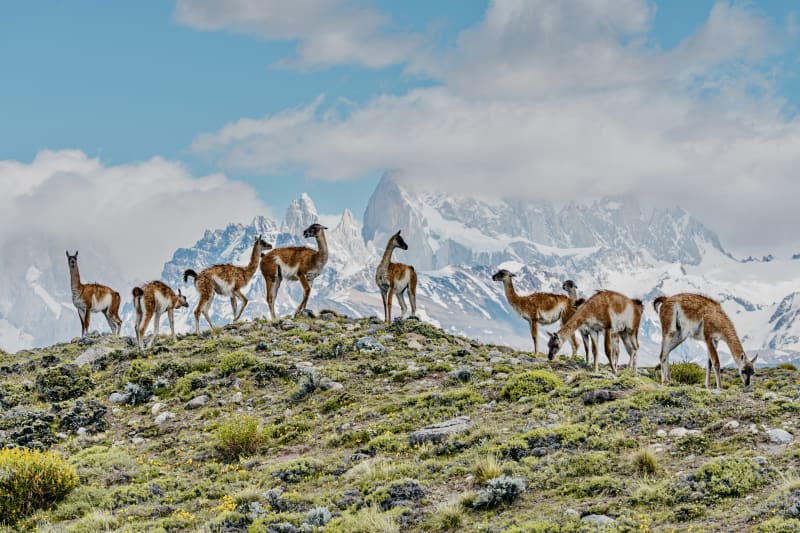
Guanaco Population Transects
Conduct distance-sampling surveys to estimate guanaco density across the steppe, contributing to long-term population studies in southwestern Chilean Patagonia.

Pali Aike Field Excursion
Walk the craters and lava flows of Parque Nacional Pali Aike, an extinct volcanic field where Patagonia's geological history is written into the landscape itself.

Climate Data & Drones
Fly drones over peatlands at Rio Rubens, monitor the Punta Arenas weather station, and build climate models in a four-hour Python and R hackathon.
Field Sites
From Grey Glacier's retreating face to Tierra del Fuego's penguin colonies: climate science where you can watch the data change.

Torres del Paine National Park
Camping expeditions studying glacial retreat at Grey Glacier, guanaco ecology, and fire succession.

Tierra del Fuego & Strait of Magellan
King penguin colony observations and sub-Antarctic cyanobacteria research.

Punta Arenas & Argentina
A long-term climate station, urban wetland waterbird surveys, and Perito Moreno Glacier.
Climate Change You Can Walk Across
Grey Glacier's retreat is measurable from where you stand. The fire scars spreading through lenga beech forests took centuries to grow and hours to burn. At the Punta Arenas weather station, long-term climate monitoring data plots the trend line you've been studying in the field. Students map glacier termini with GPS, record colony size and behavior at Tierra del Fuego's northernmost continental king penguin colony, and sample aquatic macroinvertebrates in glacial rivers, building datasets that track Patagonia's transformation from ice, fire, wind, and biology simultaneously.
Interdisciplinary & Field-Based
Five courses weave earth systems, Patagonian ecology, and conservation politics into a field-driven semester. Students survey waterbird populations in urban wetlands, compare public and private conservation at Torres del Paine and Reserva Explora, analyze water quality to track pollutants in even the most pristine environments, and learn cueca in Puerto Natales, all building toward Directed Research that addresses real questions for CONAF and local grassroots organizations.
Courses
Five integrated courses totaling 18 credits
Studies guanaco populations, penguin breeding biology, Magellanic forest restoration, invasive salmonids, and urban wetland bioindicators across Patagonia's wind-shaped habitats.
View Syllabus (PDF)Maps glacial retreat at Grey Glacier, reads geological history at the extinct Pali Aike volcanic field, monitors peatlands with drones, and builds climate models in a Python and R hackathon.
View Syllabus (PDF)Compares public and private conservation at Torres del Paine and Reserva Explora, surveys wildfire perceptions with rangers, and examines salmon aquaculture impacts.
View Syllabus (PDF)Spanish at beginner or intermediate level with cueca and chamame dance lessons, estancia visits, and a video essay tracing Patagonian cultural themes.
View Syllabus (PDF)Faculty-led research for CONAF and local partners: past projects include microplastic sampling from upland geese in Torres del Paine, black carbon monitoring on Patagonian snowpack, and macroinvertebrate responses to invasive salmonids.
View Syllabus (PDF)

Start Your Patagonia Semester
Applications are now open for upcoming semesters.
Dates & Costs
Semester program: 15 weeks, 18 credits. Financial aid and SFS scholarships available.


