


From Floodplain to Cloud Forest in One Semester
The ceiba tree rises above the canopy like a cathedral spire, once revered as a gateway to the spirit world, now standing sentinel over a forest losing ground to fire and chainsaw. Peru's Amazon holds nearly 20% of the world's fresh river water and an elevational gradient that climbs from lowland floodplain through Andean cloud forest to Polylepis groves above 12,000 feet. Few places compress this much biodiversity into a single semester's reach.
From Tarapoto, the semester climbs: laying plant plots in the Cordillera Escalera, where species composition shifts every few hundred meters of elevation, then traveling to Cusco and dropping into Wayqecha Cloud Forest to build hummingbird-pollination networks flower by flower. At the Potato Park, five Andean communities grow more than 1,300 native potato varieties, and the question shifts from what lives here to who decides what stays.

What You'll Do

Rainforest Plot Surveys
Establish GPS-referenced plots in the Cordillera Escalera to survey plant distributions and environmental variables across elevation gradients, then produce a group scientific paper.

Pollinator Interaction Networks
At Wayqecha Cloud Forest, identify hummingbird species, collect and classify pollen loads, and construct plant-pollinator interaction networks at high elevation.

High-Andes Conservation
Work alongside National Geographic Explorer Ruthmery Pillco at the Ukuku Center, studying Andean bear ecology and community-based conservation strategies.

Río Amazonas Research Station
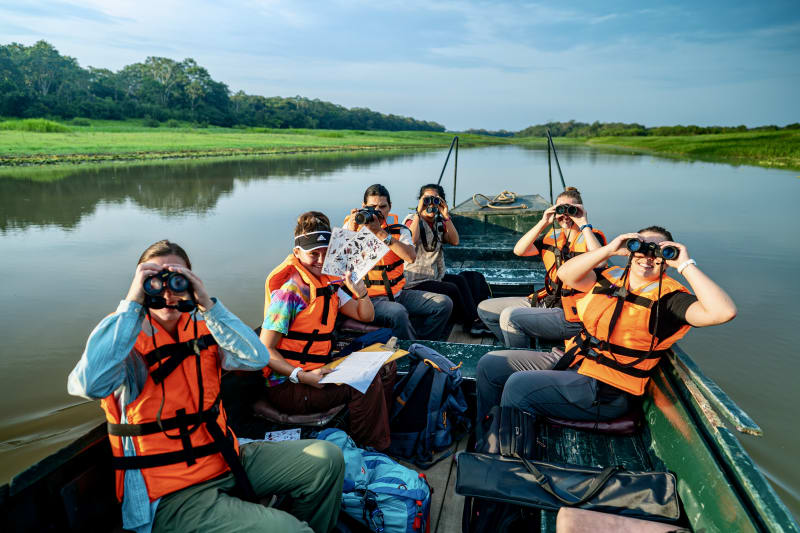
Travel the Amazon River by boat to a floating research station, surveying riverside birds, frogs, bats, and arboreal mammals for its ongoing monitoring projects.

Andean Indigenous Knowledge
Visit five Andean communities preserving 1,300+ native potato varieties, studying in-situ conservation and mapping power relations between stakeholders.
Conservation Field Research
Analyze carbon credit market impacts at the Bosque de Protección Alto Mayo through a political ecology lens and study ecological restoration at Mantanay, where three million Polylepis saplings are being planted.
Field Sites
Field sites span 12,000 vertical feet, from lowland Amazon through montane cloud forest to Cusco's Andean highlands and Polylepis groves.

Cordillera Escalera
A montane forest conservation area near Tarapoto, surveyed for plants along elevation gradients.

Santa Elena Conservation Concession
A protected wetland reserve where students study how ecotourism supports local communities.

Wayqecha Cloud Forest
A high-elevation Andean site for surveying hummingbird-pollination networks.
Riverboat. Cloud Forest. Canopy Walkway.
A riverboat expedition out of Iquitos spends four days at a floating research station on the Amazon River, running fauna surveys through the Tamshiyacu-Tahuayo Regional Conservation Area: pink river dolphins off the bow, sloths in the riverside canopy, giant river otters crossing the channel. Later the program trades lowland heat for Andean cold, traveling to Cusco and down to Wayqecha Cloud Forest, where a canopy walkway lifts students into the mist to study how the forest changes from floor to treetop.
An Interdisciplinary Amazon Curriculum
Five courses fuse tropical ecology, conservation science, and political ecology across an elevational gradient spanning 12,000 vertical feet. Students practice fauna survey techniques at the Río Amazonas Research Station, apply CMP Open Standards for conservation planning, and use Participatory Rural Appraisal tools to analyze socio-ecological conflicts, building toward Directed Research that integrates ecological data with questions of power and justice.
Courses
5 courses · 18 credits · 15 weeks
Establishes GPS-referenced plant plots in Cordillera Escalera, constructs hummingbird-pollination networks at Wayqecha Cloud Forest, and studies Polylepis ecology across the Andean moisture gradient.
View Syllabus (PDF)Practices monitoring techniques at the Río Amazonas Research Station, studies Andean bear conservation with a Nat Geo Explorer, and evaluates Payment for Ecosystem Services at Piuray Lake.
View Syllabus (PDF)Examines indigenous territorial conflicts using Participatory Rural Appraisal, studies ecofeminism at Bosque de las Nuwas, and analyzes REDD+ carbon credits and rubber boom legacies.
View Syllabus (PDF)Spanish at beginner and advanced levels, cultural outings with Amazonian and Andean communities, and written field reflections comparing highland and lowland traditions.
View Syllabus (PDF)Faculty-led research: past projects include frugivorous bat seed dispersal across agricultural gradients, subsistence hunting impacts on mammals, and environmental justice in the Cordillera Escalera.
View Syllabus (PDF)

Study the Amazon Firsthand
Now enrolling for Spring 2027 and Fall 2027.
Dates & Costs
Semester program: 15 weeks, 18 credits. Financial aid and SFS scholarships available.


