


Every Meal Has a Thesis
Olive groves climb the hillside in rows that haven't changed since the Etruscans planted them. Vineyards ripen under a sun that arrives earlier each year and stays longer. Tuscany's food traditions have fed civilizations for millennia, but rising temperatures and shifting rainfall are rewriting the conditions they depend on. At the SFS center in Greve in Chianti, the question is whether these systems can adapt fast enough.
You kneel between Chianti vine rows and count earthworms, then watch which pollinators turn up and which don't: the bluntest evidence of whether conversion is working. Off Lipari in Sicily's Aeolian Islands, fishermen haul nets set the same way for generations; you prepare prawns for direct sale while still on the water and study how EU fisheries policy compares with US practice. An 'English for Pasta' exchange pairs you with Italian families: you tutor them in English, and they cook you dinner and trade conversation in Italian.

What You'll Do

Vineyard Biodiversity Surveys
Identify state and pressure indicators in organic and conventional vineyards, measuring how management practices shape plant, insect, and soil communities across Chianti estates.

Soil Health Assessment
Assess soil quality across farm sites using the QBS-e earthworm-based protocol, a field method linking below-ground biodiversity to long-term agricultural sustainability.

Aeolian Islands Field Trip
Fish with Lipari's artisanal fleet and prepare prawns for direct sale on board, mill ancient grains for pizza with island farmers, and hike the crater of Vulcano.

GIS & Farm Mapping
Learn QGIS across six hours of workshops, georeferencing agricultural data and creating land-use maps that visualize how food systems pattern the Tuscan landscape.

Etruscan & Roman Agriculture
Visit the Cetamura archaeological site and Museo Mezzadria to trace how Etruscan, Roman, and sharecropping systems shaped the landscape students study today.

Permaculture & Farm Design
Apply systems thinking to redesign a real farm orchard using permaculture principles: assessing water resources, energy flows, and biodiversity integration.
Field Sites
From Chianti vineyards to Maremma's coastal wetlands to the Aeolian Islands: three biogeographic regions in one semester.

Chianti Vineyards & Farms
Organic and conventional estates where you survey soil biodiversity and study short food supply chains.
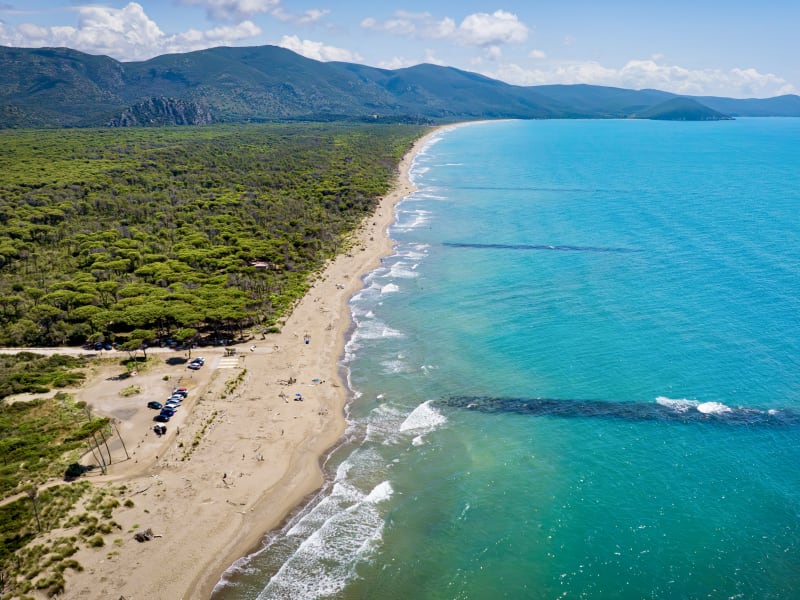
Maremma & Orbetello Lagoon
Coastal wetlands and Mediterranean maquis, where students birdwatch at the WWF's lagoon station.

Casentino Mountains & Sicily
Chestnut groves around Foreste Casentinesi National Park, and an Aeolian Islands field trip.
Three Thousand Years of Farming. A New Climate.
You kneel between vine rows and count earthworms. You survey pollinators on the same estates where wine has been produced since the Etruscans. On the Sicily field trip, you haul nets with Lipari's fishermen, pick lemons and pomegranates straight from Salina's trees, and climb Vulcano, the island that gave every volcano its name. In Casentino's chestnut groves, traditional agroforestry endures alongside the region's organic bio-districts; nights are spent in a monastery near the Sacred Forests, cooking trout caught inside the park with the InQuiete association. Sicily's island vineyards show what happens when an ancient food system meets a new climate without the mainland's buffer. One evening ends in a Lipari church, love songs echoing beside a nativity the island's fishermen built by hand. Fifteen weeks across three Tuscan landscapes (Chianti's vineyards, Casentino's chestnuts, Maremma's coast) and one Sicilian archipelago, asking whether biodiversity and food production can reinforce each other.
Fieldwork From Chianti to Sicily
Five courses weave food systems ecology, resource management, and systems thinking for the future of agriculture into a field-driven semester. Students survey soil biodiversity in Chianti vineyards, visit organic rice and milk farms, analyze EU agricultural policy through Etruscan archaeology, and travel to Sicily for Mediterranean food systems research, all building toward Directed Research mainstreaming biodiversity from field to fork. In Foreste Casentinesi National Park, students join the park's wolf experts, veterinarian, and director for lectures and fieldwork on the Apennine wolf: fall cohorts help the annual deer census by recording rutting calls, while spring cohorts classify camera-trap data. Classes travel too: on the Aeolian trip, a lecture on the EU's Natura 2000 network takes place in a museum of antique tiles.
Courses
Five courses weaving agroecology, food heritage, and climate science together across Tuscany's working landscapes.
Surveys biodiversity across three Tuscan landscapes (Chianti vineyards, Casentino mountain pastures, and Maremma coastal wetlands), measuring how food production shapes ecosystems.
View Syllabus (PDF)Studies agroecological transition through GIS mapping, soil quality assessment with the QBS-e protocol, bioindicator monitoring, and visits to organic rice and milk farms.
View Syllabus (PDF)Analyzes EU agricultural policy through Etruscan archaeology, permaculture design workshops, ecosystem service valuation, and small-scale island fisheries in Sicily.
View Syllabus (PDF)Italian at beginner to advanced level with regional cooking classes, a Sicily cultural trip, and 'English for Pasta' exchanges with local families.
View Syllabus (PDF)Faculty-led research mainstreaming biodiversity from field to fork: past projects include soil health assessment with the QBS-ar index across Tuscan farms, lizard bioindicators in Chianti vineyards, and multidisciplinary riparian-zone restoration.
View Syllabus (PDF)

Your Semester in Tuscany Starts Here
Apply now to join the next cohort at the Center for Sustainable Food Systems.
Dates & Costs
Semester program: 15 weeks, 18 credits. Financial aid and SFS scholarships available.


