Australia

Wake Up in
the Rainforest

Explore North Queensland's tropical rainforests and savannas. From the Great Barrier Reef to the Atherton Tablelands, study climate change and conservation.

A Campus Under the Canopy

Being a student at SFS Australia means living and studying inside one of Australia's most remarkable ecosystems. The 153-acre campus of the Center for Rainforest Studies sits within diverse rainforest and drier rainforest regrowth on Queensland's Atherton Tablelands, close to the UNESCO Wet Tropics World Heritage Area and Danbulla National Park. The biodiversity here is dense enough that wildlife finds you: colorful pigeons and Australian riflebirds in the canopy, bandicoots and striped possums after dark, tree frogs calling from the leaves, and an astonishing range of invertebrates.

Students live in cabins under the canopy, waking to birdsong and falling asleep to rain on the roof, frog calls, and the occasional screech of a striped possum. Days start early and sometimes run past dinner: field lectures and excursions across the Atherton Tablelands one day, classes on campus with CRS faculty the next. Four courses build academic skills and field techniques through excursions into rainforest, drier biomes like savanna, and the Great Barrier Reef. Students also learn these environments through Traditional Ecological Knowledge, shared by Mandingalbay Yidinji and Mbabaram Traditional Owners.

A free-diver descends beside a coral outcrop in the tropical waters of Far North Queensland
1987
Year Established
153
Acres of Rainforest
600+
Species of Vertebrates
2
UNESCO World Heritage Sites

Rainforest Canopy to Coral Reef

Field exercises run through all three disciplinary courses. Tropical Biome Ecology students set up transects on campus, collect data on trees, and compare their plots to datasets from across the Atherton Tablelands. Wildlife and Conservation Biology brings animal observations, camera trapping, ant trapping, and hands-on rainforest restoration. Environmental Sustainability and Socioeconomic Values teaches social science in the field, from human-perception surveys about local wildlife to the study of Traditional Knowledge. Directed Research data feeds long-term datasets that support landholders, conservation groups, and government agencies across the Tablelands.

Explore Our Research
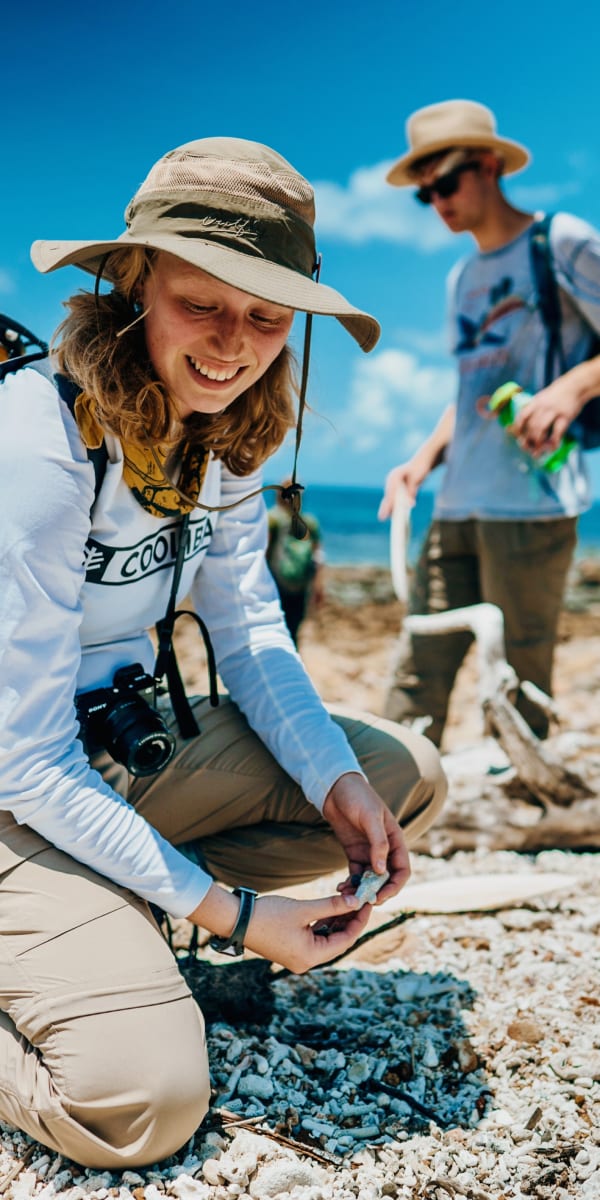
Students conducting research on a tropical beach near the Great Barrier Reef
Students examine coral fragments on a rubble beach in Australia

Hands-On Field Methods

  • Rainforest Vegetation Surveys

    Map canopy structure and species composition using transect plots and point-quarter sampling
  • Wildlife Monitoring

    Track tree-kangaroos, possums, and other marsupials through nocturnal spotlight surveys
  • Water Quality Analysis

    Test stream chemistry and macroinvertebrate indicators across catchment gradients
  • Reef Snorkel Transects

    Survey coral cover, fish assemblages, and reef health along the Great Barrier Reef
  • Camera Trapping

    Deploy motion-activated cameras to document mammal activity along forest corridors
  • Community Surveys

    Design and conduct social surveys on land-use attitudes with local stakeholders
  • GIS & Spatial Analysis

    Build habitat maps and land-cover models using GPS data and GIS software
  • Lab Specimen Analysis

    Identify invertebrate and plant specimens under dissecting microscopes

Faculty in Australia

Spring 2026

One Tree Kingdom of the Bryophytic Realm

A fallen tree brought a normally unreachable canopy down to ground level, and students recorded every moss and liverwort living on that single trunk, a community otherwise hard to sample.

Spring 2026

Microbat Acoustic Survey at Bridge Creek Crossings in the Wet Tropics of North Queensland

Microbats make up much of the region's mammal life and almost none of its research. Students recorded their ultrasonic calls at creek crossings and matched them to species.

Spring 2025

Exploring Platypus Habitat Traits in Far North Queensland, Australia

Platypus records across the Tablelands are patchy, so students surveyed private waterways to pin down the habitat traits that predict where the animals turn up, reporting back to landholders.

Spring 2025

Preserving Mbabaram Knowledge: Documenting Significant Species and Their Traditional Uses

Working at Watsonville, students recorded the species that carry meaning in Mbabaram culture and the uses held for them. The work grew into a biocultural field guide and bushwalk signage.

Community & Culture

The center sits on 153 forested acres at the end of a winding road. Four cabins sleep six to eight students each, tucked deep in the rainforest alongside a bathroom block with hot-water showers, an open-air dining area, a classroom, and a newly renovated student recreation room. There is no air conditioning and WiFi is very limited. The trade is a campus wrapped in rainforest, with wildlife for neighbors around the clock. Yungaburra, the nearest town, is a twenty-minute drive with a doctor, pharmacy, and supermarket. Most trips off site are academic excursions, broken up by long weekends in Cairns: five per semester, one to two days each, for a taste of city life.

Students partner with TREAT, Landcare, and local landholders on revegetation projects that feed long-term datasets. Aboriginal Traditional Owners (Yidinji, Mbabaram, Ngadjon-Jii) share cultural traditions and connection to Country through cultural experiences and field excursions. The Daintree Blockade site connects the forest to Australia's environmental movement and World Heritage listing. Community-driven corridor projects and canopy bridges across the Tablelands show what reconnection looks like on the ground. Each semester culminates in Community Research Night: presenting findings to the farmers, volunteers, and agencies whose land and livelihoods the data supports.

Study abroad students laughing together while crossing golden Australian grasslands

Ready to Study in Australia?

Enrolling now for Spring 2027, Summer 2027, and Fall 2027.

Apply Now