Environmental Inquiry

Research
in Context

Since 1984, SFS faculty, students, and staff have authored over 500 scholarly works.

Explore Publications ↓
Long-term marine research at SFS

Permanence

Our centers are fixtures in their communities. Kenya and Australia have welcomed students since the mid-1980s, and Costa Rica and the Turks and Caicos Islands since the early 1990s. That longevity changes our impact: short-term studies describe a snapshot, but long-term effort reveals patterns in ecosystems and in the communities they support.

A group of students gazes upward into a dense rainforest canopy during a group observation

Real Questions

Students conduct research, not a simulation of it. On some projects that means shaping the question and designing the method; on long-term studies it means holding to protocols precise enough that their data extend years of prior work. Students have co-authored 77 papers in the SFS research record.

Community and conservation work in Cambodia

Community Reciprocity

Our neighbors share what they know and how our work can complement their own. In return, we support community partners and government agencies with data that informs their decisions. Each center keeps an ongoing strategic research focus, so every semester's findings build on the last. Students benefit from the long-term partnerships our full-time faculty build at each center.

Students conducting field research in Chile's Patagonia
Hands-on lab research in Panama
A student crouches in lush green forest writing field notes during fieldwork in Panama
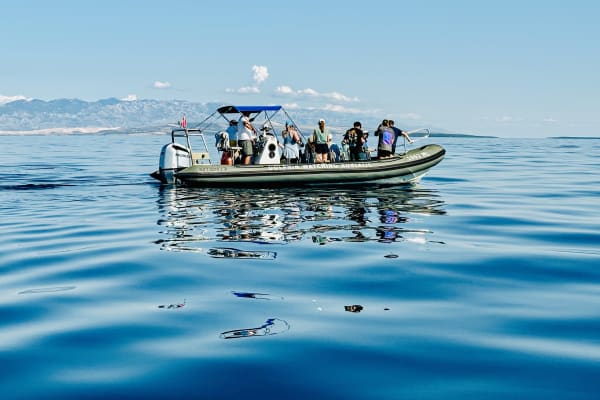
Students aboard a research boat along Croatia's Mediterranean coastline

Skills You Carry Forward

From species identification and wildlife monitoring to GIS and stakeholder interviews, the skills you learn at SFS are practical and transferable. Each student works directly with a faculty member through the whole research process, from project design to final written report.

Recent Directed Research titles Spring 2026 (PDF) Fall 2025 (PDF)
Students examine a small bird in hand during field research in Costa Rica's forest
A spotted leopard sits alert in lush green grass
Hands-on wildlife research in Croatia
A small olive-green bird rests in a researcher's hand in Costa Rica
Methods You'll Practice
  • Species Identification

    Identify the mammals, birds, reef fish, and plants of your center by sight, sound, track, and sign
  • Camera Trapping

    Set and retrieve motion-triggered cameras along wildlife corridors, then turn the images into data
  • Transects & Sample Plots

    Lay out standardized transects and plots to track vegetation, coral, and seagrass over time
  • GIS Mapping

    Georeference data in the field, then map habitat and land-use change in GIS software
  • Water & Habitat Sampling

    Test stream, lake, and coastal water chemistry and sample sediments and macroinvertebrates
  • Reef & Marine Surveys

    Survey reef restoration sites underwater, or log dolphin sightings from a research vessel
  • Stakeholder & Community Interviews

    Run household surveys and semi-structured interviews with farmers, fishers, rangers, and neighbors
  • Analysis, Writing & Presentation

    Run the statistics, write the formal Directed Research report, and present it to the partners who use it

Directed Research by Center

Every center keeps its own record: the projects students completed over recent semesters, the faculty who advised them, and the student authors behind each title.

Meet Our Faculty

Our Publications

The full scientific record of SFS research, searchable by author, center, year, or role.
Over four decades of fieldwork across 17 research centers.

Showing 502 of 502

No Publications Found

Try adjusting your filters or search terms to discover more research.

Continue the Research

Meet the faculty behind the data and explore the centers where the work happens.